

Dear friends and family,
I am sitting still today at “anchor” (to be explained later)
The forecast is for less than five knots of wind, from the north which would be a favorable direction, but one finds that when there is no auxiliary motor, that if the wind stops altogether it takes rowing to get to an anchoring spot.
And rowing this boat turns out to be a challenge. Usually when I am rowing now it is to get the boat into a somewhat sheltered spot for the night and on the way to that spot is a significant amount of rowing in one foot of water. With that depth I cannot use the lifting keel or the rudder, since they would drag. So rowing without either makes the boat want to round up into the wind and fighting that takes a lot of energy and lopsided rowing, which saps energy. Still, I somewhat enjoy that experience. Figure that out.
Yesterday afternoon I spotted an estuary on the chart and since the wind was dying and I was tired, I decided to head for it to anchor for the night. So, I headed towards land, in this case the Matagorda Peninsula, which shields the Bay from the Gulf. I sailed until I could see bottom mud, dropped the main and set the oars in the sockets. It looked like a deep channel in the middle so I rowed towards it. Turned out it was deeper than the surrounding water , which means it was almost a foot deep. Since the wind was supposed to change to east overnight I wanted to be sheltered from that side so once I went aground, I jumped over and pulled the now significantly lighter boat onto the mud shelf. Think African Queen getting pulled downriver. Soon I was set for the night under my tent.
The weather report forecasted little to no wind for the next day, so I thought I might stay here to relax and enjoy the setting and off to sleep with that plan in mind I went. It was late. Already after seven PM so dark by now.
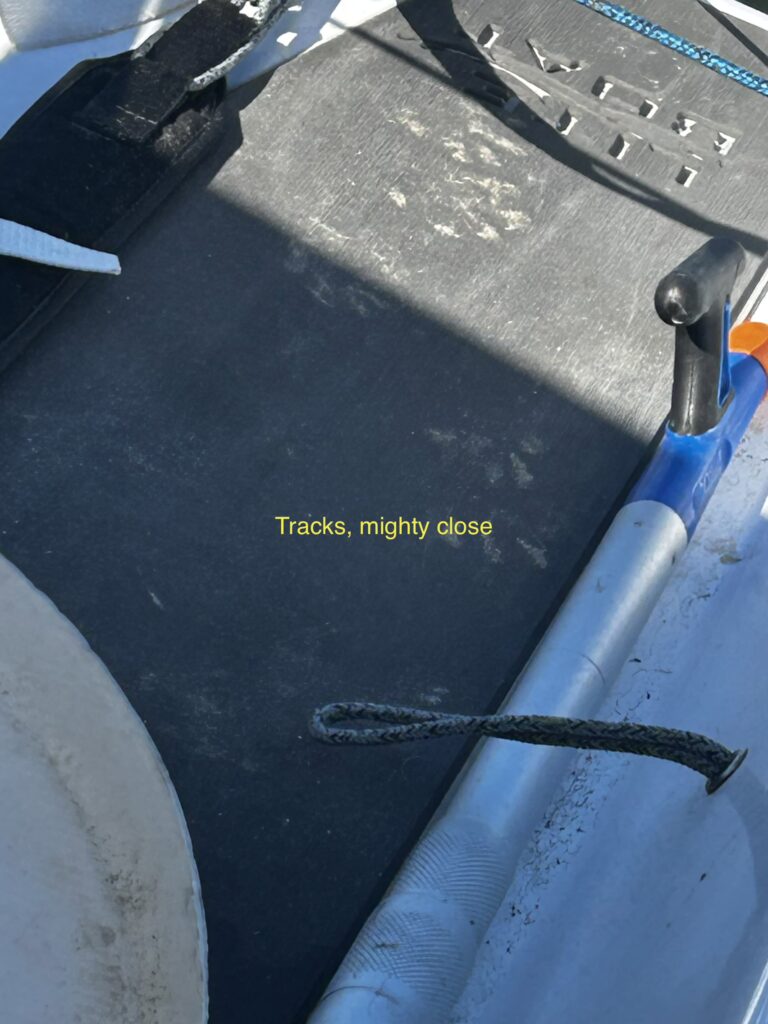
I woke to a rustling in the cockpit and then even more of a loud rustling and I realized that I had a visitor ON THE BOAT. I screamed loudly and it left in a joining of adrenaline for both of us. I crawled out from my coffin style bunk and looked out and realized that I was on dry land. The tide had fallen and left me high and dry, which is why it was easy for the coyote (left footprints on deck) to access the boat. I took out the boat horn and the large spike I use for attaching myself to land as defense, and tried to return to sleep. The fact that it was about three feet from my head gave me much to think about. Who needs interval training for maximum heartbeat?
Ready for a return visit, I laid awake. Then another set of thoughts crossed my mind: what if l am high and dry and cannot get off this mud bar? I know I can barely drag the boat over dry land. I looked up the tide tables and found that high tide was at six PM today. Let’see, oh yeah, I was planning on staying today and this confirmed it.
But what if: I am stuck here and the returning tide doesn’t get as high? No sleep now, for my mind was problem solving. I have three blow up boat rollers that I could get under the boat to roll it to deeper water (or in this case “water”), so “shut down the problem solving and get some sleep already” , I tried to tell myself.
The tides in this part of Texas are a mix of diurnal ( one high and one low per day) and semi diurnal (two highs and two lows per day). The tidal range is small, could be under a foot , so that the days weather can affect the range more than the predictions. Once I learned this I didn’t feel like such a dope. For reference, in Southeast Alaska, the tides are all semi diurnal and can range from eight feet up to twenty feet. And in the shallow waters of Texas it doesn’t take much change to dry an area out, as I learned.
Still, lots of “what ifs” surfaced in my very awake mind.
So, I could wait today, like I planned, and then move the boat at the high tide to a place I could get out at low tide in the morning, and my problem would be solved. So, finally sleep found me and I slept till seven.
Weird,no matter how many adventures I go on,it seems to take me about three days to adapt. When I Ieft Palacios two days ago,I was nervous and was cold and uncomfortable. The cold was from seventy degrees air temp, but strong winds I was sailing into (tacking) over fifty seven degree waters with the occasional splash over the bow. I was still cold when I went to bed that first night. Everything felt hard.
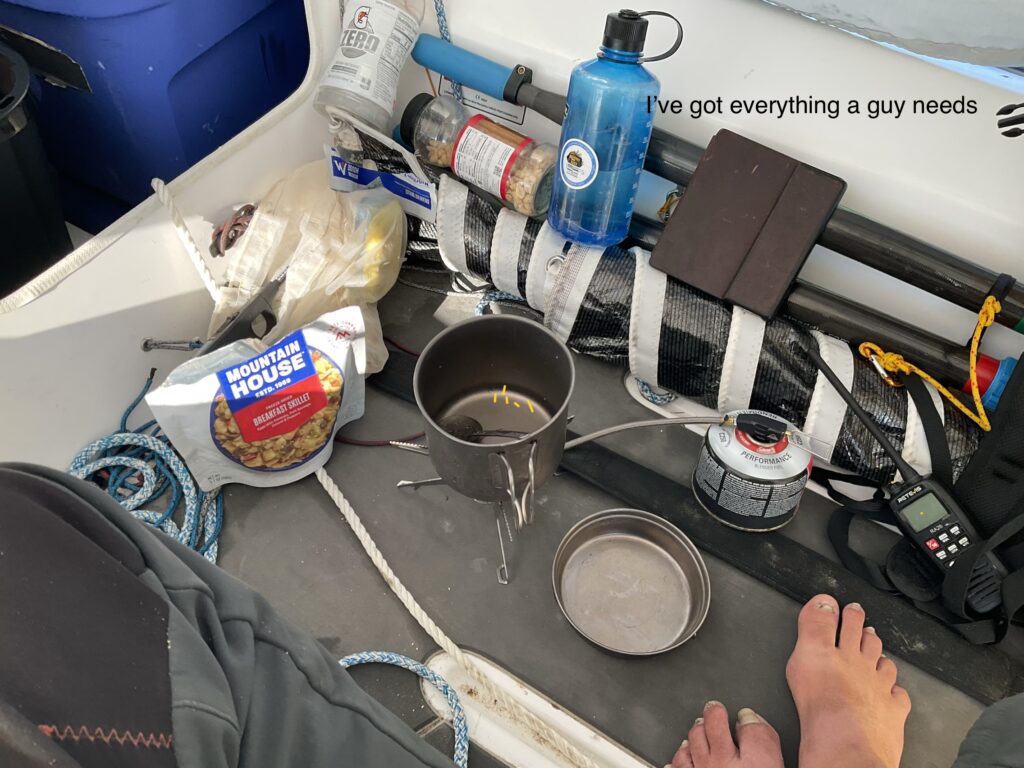
Now, a couple of days later, I made a list of what might be missing in my life onboard and couldn’t find anything to put on it. I have food, water, TP, books to read, lots of warm and dry clothes and a somewhat comfortable environment. Must be day three.
Sending love,
Charley
Hey Charley,
You sure know how to live it up!
I can’t say I recall ever boating [or wading…] in an area where the high tide is still below sea level on occasion, but I do understand; I have absolutely been in situations where I coveted a few more inches of water…
Taking those few drams of water into account, [they do measure tidal flow in drams there, don’t they?] I suspect you will be fine with your conservative 75:1 anchor scope… [or is it 100:1?]
But wait; if the water at the anchor is only 6″ deep, double both those scope ratios! And just to make sure, you may want to consult Pythagorus regarding the impact high tide will have on your scope ratio…
You can even mock this up in full scale if your next motel room has a bath tub…
Day 3 you say… that probably explains how the coyote honed in on you while sniffing around in the primordial ooze… 😉
Keep livin’ the dream, Charley! Appreciate you sharing…
Safe travels!
Cheers, Bill
PS: I apologize for any typos, but I can hardly see through the tears…
Thanks Bill. I was looking for advice from an experienced mariner. Guess I got the scope bit right.
You’re living on the edge…
Well, Charley, you sure live the wild life and with the wild life! Probably better a coyote than an alligator or some of the other critters that hunt the low tide flats. What a wild adventure you are having. I so appreciate that you’re sharing it with us. As I read your narrative, I’m reminded that we still have miles to go before we sleep. So much life yet to live.
Be well my friend,
John
good writing
I just had to jump in with the Heritage gang and check in with you. I’ve been hoping that this cold weather wasn’t messing with you too much. Nineteen degrees one night here in South GA but hopefully it’ll be warming soon. Cheers my friend, and “smooth” sailing to you.
The changes in water depth in many of the very shallow bays on the Texas coast are often as much a factor of the direction and strength of the wind as the actual tide driven by the pull of the Moon and/or Sun. For instance in southern Laguna Madre a strong N wind over a period of time will cause it to be more shallow in the northern part and less shallow in the southern part. In the Summer the opposite is common with strong winds from the southeast jamming water up against the narrow northern end of the southern Laguna Madre. I expect it is much the same in other bays along the Texas coast. The actual outlets to the open Gulf of Mexico are narrow, and few so the volume of water going in and out of the bays is less than you might think.