
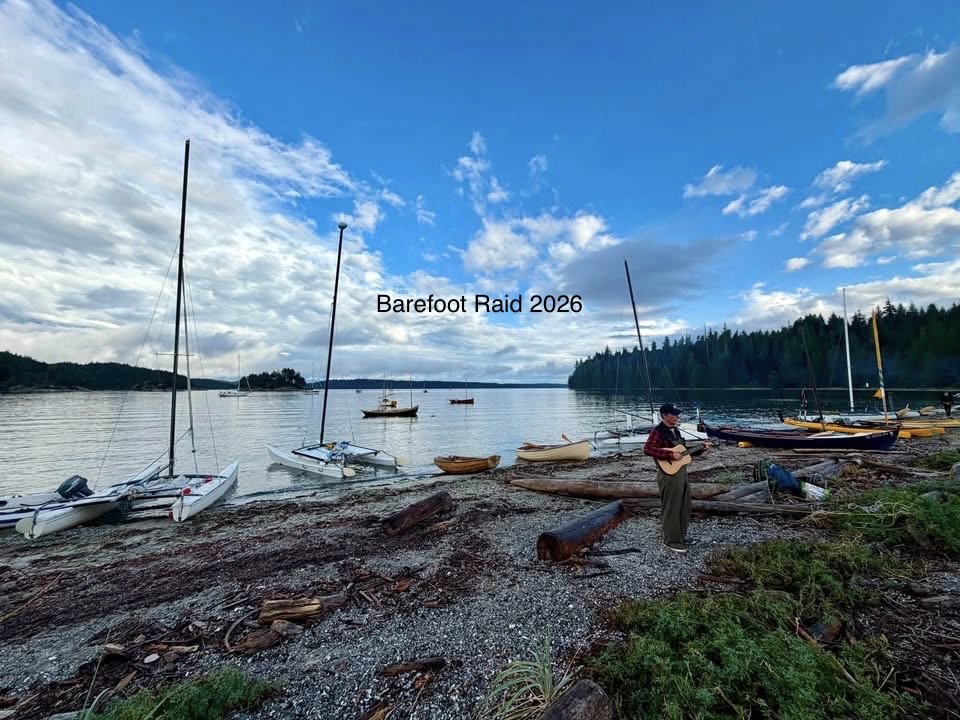
Dear friends and family,
First of three posts on the Barefoot Raid.
Snark and I just returned to Port Townsend after eight days of the Barefoot Raid.
I am very sore, finally drying out after being wet every day for eight solid days, and finally my sleep has caught up where my mind works as usual (note that I didn’t say “well”)
What is a Raid?
According to Wikipedia it is “a leisure pursuit involving a fleet of small boats capable of rowing and sailing, exploring a coastline or inner waterway over several days, often with a competitive element.”
I think this raid is called barefoot to remind us that it is very informal. To say the least.
I had an idea to sail in Desolation Sound at the end of August and tripped over the Raid site, which announced this group sail in the north end of Georgia Straits the same time, so I joined up. Having no idea what a Raid was about I got more and more nervous as the time approached.
For me it involved trailering the boat to Port Angeles, then riding the ferry across to Victoria followed by more than three hours driving up the coast to an RV resort and marina called Salmon Point. This is where all the raiders would meet and launch.
A truck pulling a beautiful wooden boat pulled on the ferry behind me and the driver asked if I was the one who bought this Liteboat from his brother-in-law, which was true. I knew it would be a small world of boats then.
We helped each other assemble our boats and launch for the start the next day.
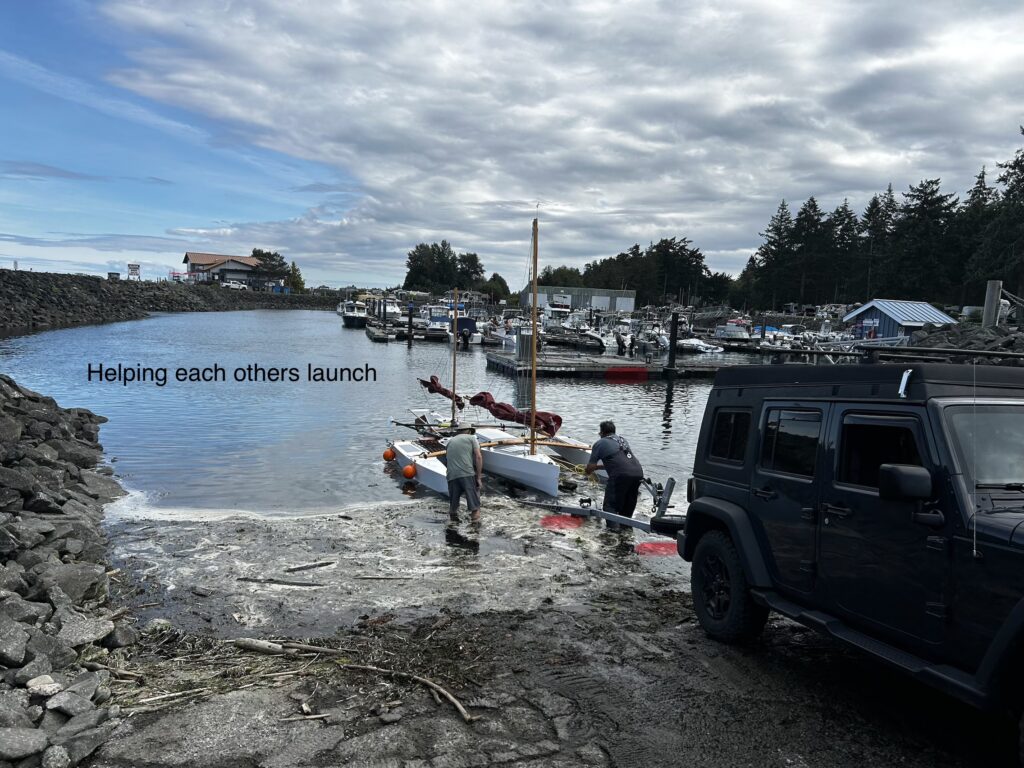
There was quite a collection of different boats, from homemade rustic boats to go-fast catamarans to my model of carbon fiber French built Liteboat, joined by a sister ship.
In early discussions I found out that several of the sailors had participated in the Race to Alaska, a 750 mile non- motorized race from Port Townsend to Ketchikan, Alaska, and some several times.
I’d rowed and sailed this boat once before, on my Texas trip, so I was close to the same expertise as these experts- NOT!
Even rowing, I was intimidated not only by the experience of others racing and rowing to Alaska, but a former Canadian Olympic rower as well.
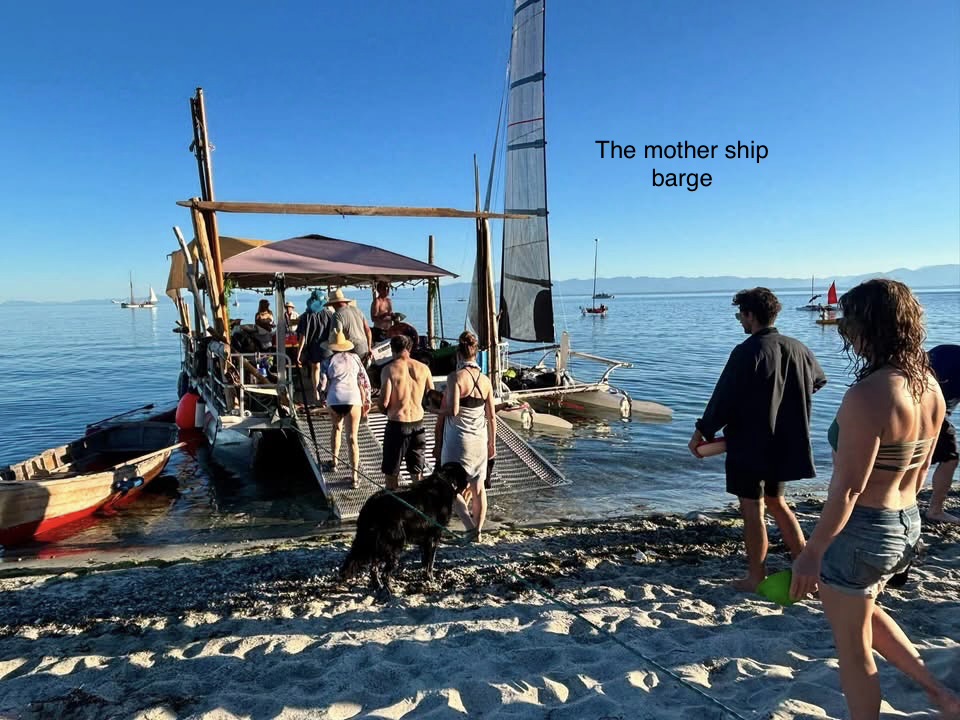
Over eight days we had lots of long distance rowing, up to four hours in the morning and often more in the afternoon. The good news is there was a barge with cooking setup, and cooks preparing three meals per day for us, so post rowing one didn’t need to scrounge up food.
The food was quite good and I appreciated all the salads and fruit and vegetables offered. And quantities were adequate too. Everyone brought their own bowls to fill them up from the barge mother ship. You could call it organized chaos, but more chaos and less organized.
The mother ship was a pontoon barge with a ramp to shore, like a barge landing craft. Because of the tidal exchange, it often would be just offshore, enough to have to walk into thigh deep water to get your dinner. Good thing the water was warm up here in northern Georgia Strait.
We started in a no wind situation which meant miles and hours of rowing. I love to row, but was challenged by the untested oars that we put together before the race, that turned the blade as I rowed, needing adjustment every ten strokes. Not exactly efficient and also pulled to one side, so of course my arm and shoulder are still suffering from the sideways stroke.
Over the course of eight days, we had hot sun and no wind, so rowing in the heat. The next day might offer big winds and crashing through largish waves in this little boat. Once in these conditions it seemed a lot less scary than looking at them from shore.
Most of the sailors had boats that they could pull up onshore, then set tents for sleeping. With Snark, if I dried out at a low tide, I might miss the next day, unable to get off the sand spit, so I either had to move the boat every half hour with the tidal change or anchor deep enough to float at all levels of tide. As the week wore on, I chose to anchor deep in the first place and wave and beg a ride ashore for meals and skipper meetings. There were only 4 or 5 of us that slept aboard our little ships, so the focus was mainly on comfort for the shore based boats.
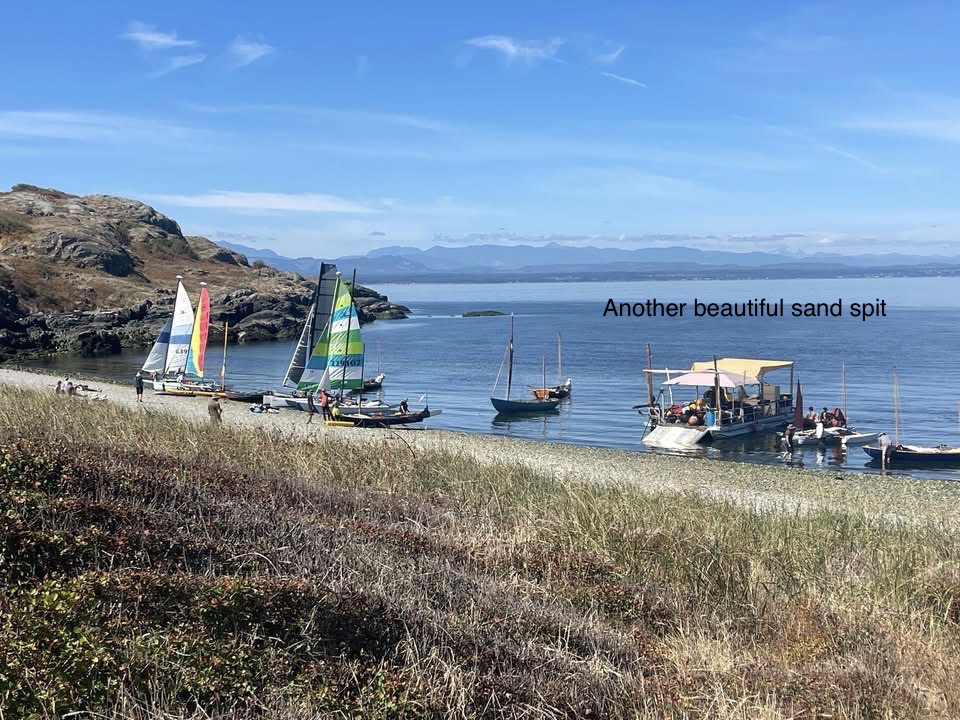
I had a three day period anchored in ugly chop that kept me up all night. Not a place of exposure to the weather that I would choose, but to stay with the group had to suffer it. The boat is flat bottomed in the stern so each wave would slap it down while shaking the whole boat and the skipper in his coffin cabin.
The barge had a tent over it,but with the cooks, refrigerators, freezer, generators and gear from all the boats left little room for the sailors to congregate. So, often we would be standing out in the rain on the beach eating our dinner and socializing.
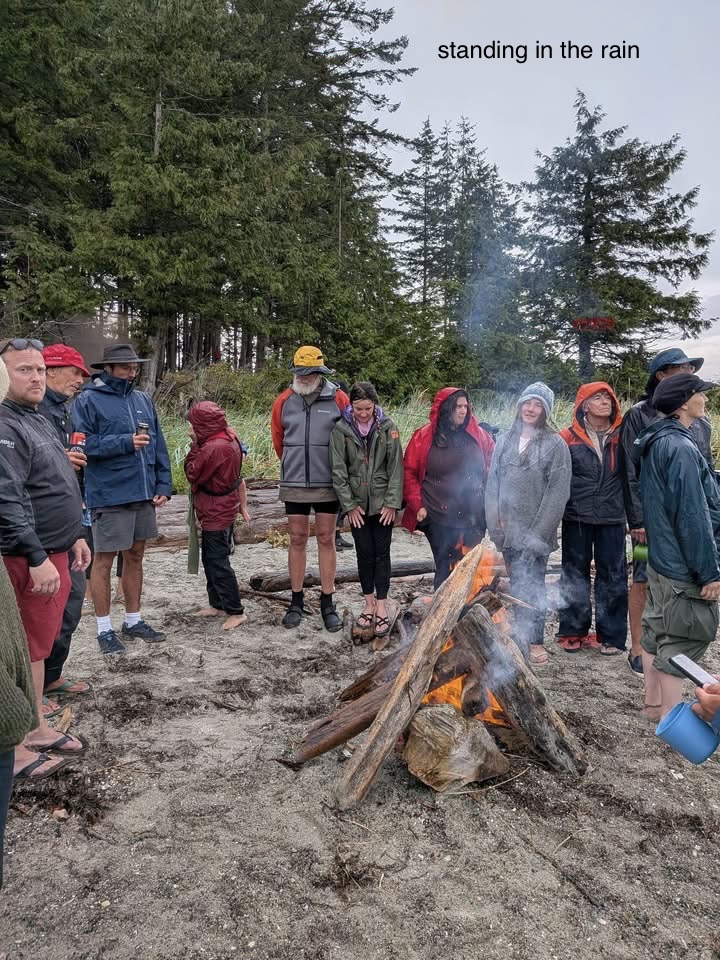
So, picture my evening: I have a heavy rainproof jacket on top and bathing suit below. Landing on the beach I get wet up to my crotch. Then traversing to the barge, get wet again to get my dinner and back to the shore. Then stand on the shore in the wet bottom while the sun goes down and the wind blows, making it quite cool. Followed by a ride out to Snark at anchor to put up my cockpit tent and change into something dry and try not to get my sleeping back too salty or wet as I crawl into it inside the coffin sized cabin to sleep. Or try to while the boat is slamming into the chop of the anchorage. Then wake up and start it again with breakfast and a boat race.
To be continued…
Sending love,
Charley
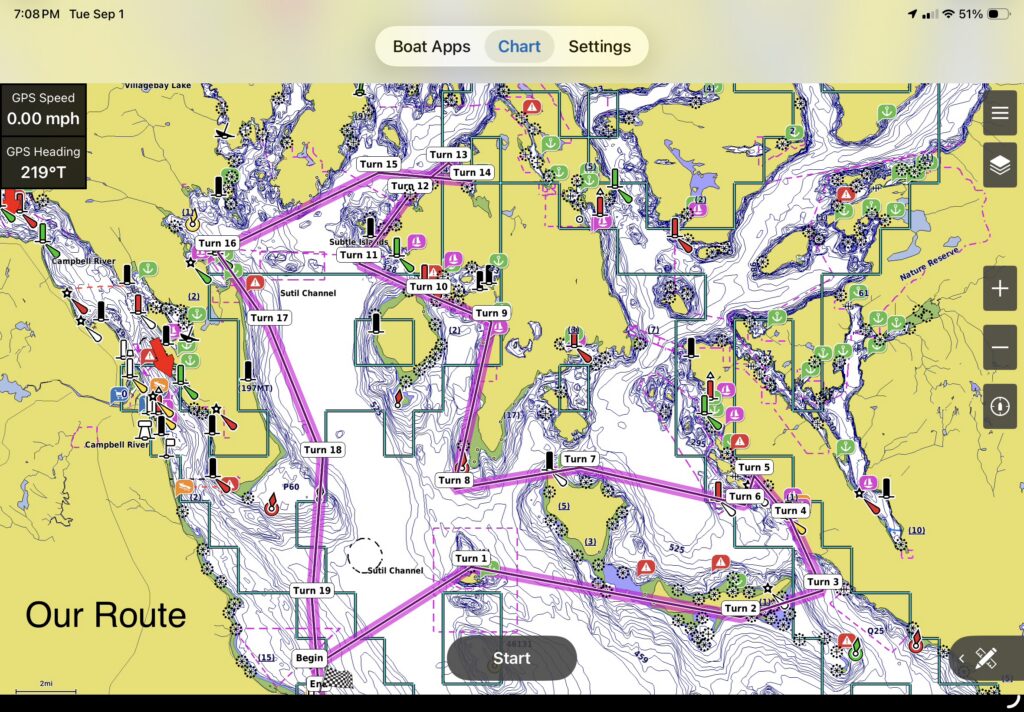
So I guess in the next two posts you will get to the fun part?
It was fun, but type 2 fun
Charlie, that picture says it all!! Ha
Love it. I’ll be putting out a new blog soon also with our good friend Pinto.
Glad your home and warm, fed, and safe.
I guess the fun is the challenge. Quite a challenge. Nice to socialize with all these like souls. Too bad you couldn’t have been a little more comfortable, at least sleeping.
Looking forward to the next post.
Will you do it again? Probably too early to decide.
I guess suffering is part of the Challenge?
Ha! Well you definitely got some good stories out of the “raid”! And hopefully got some wonderful humpback connections too! 😁